Prices in Gold

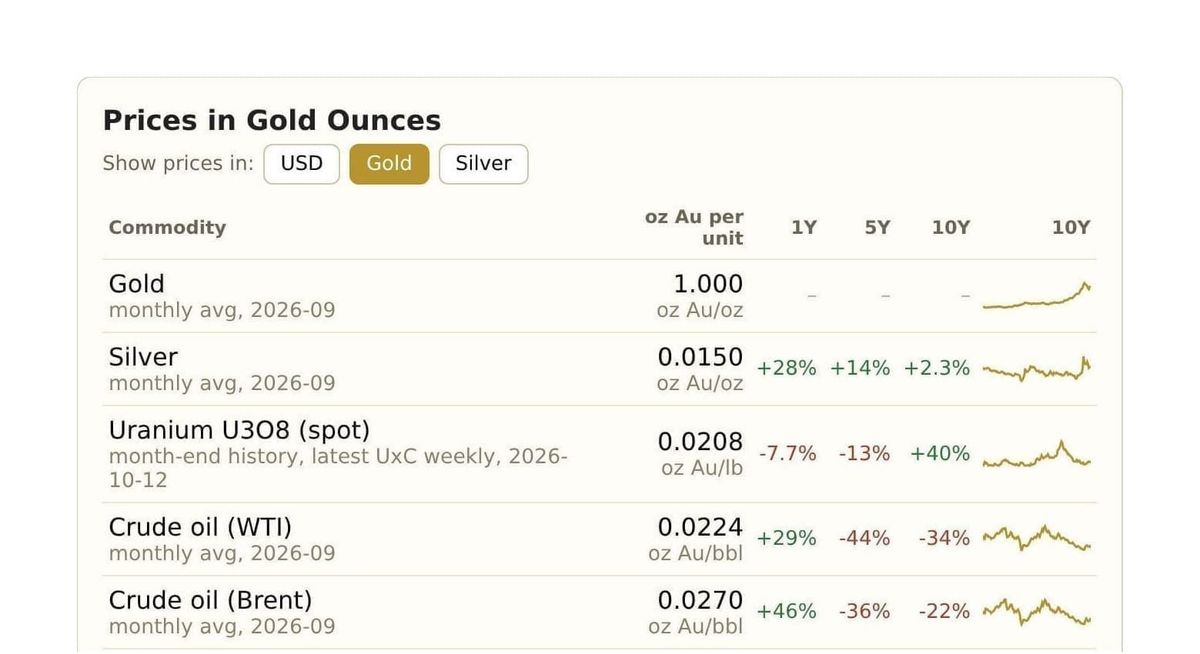
Most of what you will read this week prices everything in dollars. This issue gives you a cleaner reference: the same prices measured in gold. One filter that reduces noise so you can judge value with less interference.
In this issue:
• What are prices
• The noise problem and the gold filter
• The new Prices in Gold model
• A few links worth your time
I’m testing what a paid option could look like without turning this into a paywalled newsletter. What product or service would you pay for?
It takes under a minute, and your answer shapes the future.
A Mindset for Prices
What I value most from studying economics is what I gained from Classical and Austrian Economics. Specifically a priori knowledge, "what is from before" knowledge. This comes from pure deductive reason and logic, before physical experience or observation. Every principle flows from the principle that came before. This is the essence of Bastiat's 'That Which is Not Seen'.
Austrian economics delves deeply into the science of marginal utility, and the subjectivity of value. Value being subjective by nature, is the reason for market prices. In a sea of subjective chaos, there has to be structure and order for producers and consumers to make long term decisions. This gave rise to pricing systems, where buyers and sellers are the bid and offer, this is the market. And that's why free markets, or pure prices free from interference – free from noise – are viewed as the holy grail by the Austrian School.
Value comes from worth. Ratio comes from reason and calculation. Price comes from value, reward and money spent. Prices are simply ratios that have a common denominator, that is the unit of account. Today the dollar is the unit of account, it is the prevailing pricing unit. Gold is priced in dollars, oil is priced in dollars, because the US is the dominant global economy and has the strongest currency.
Historically prices were measured in weight of physical goods; pounds sterling, pesos de ocho, dollars. The sterling was a troy pound of 92.5% silver. The peso de ocho was half of a spanish pound, 8oz. The dollar, 'thaler' was a one troy ounce silver coin from Saint Joachim's Valley in the Czech Republic, then the heart of the Holy Roman Empire. Today, a dollar is worth 0.0167 troy ounces of silver, a reduction of 98.5% in value.
Along with that, it is the price of money itself that is vital for economy. The interest rate is the cost to borrow money now. Which is why there is a Net Present Value and a discount window. And that leads down the road of monetary creation, inflation, and fractional reserve banking, which has its own way of distorting prices.
The Problem with Pricing Models
Besides the subjective nature of value itself, prices provide us with as close to an objective market perspective as there is. The goal being to obtain objective clarity in regards to true value. That means the pricing problem becomes a very simple problem, too much noise. The caveat is that this is a rather large problem. There has never been more noise in volume and the velocity has never been faster.
By recognizing the Government as a market participant on the bid and ask we eliminate a lot of interference that is generally already priced in. What we can't do is accurately foresee every policy change and its consequences in the markets. We can see a lot of them coming and we can make some very accurate guesses simply by looking at historical comparisons, but to precisely predict the effect on a specific price is impossible. Some market participants will also see these coming and position accordingly, others won't and will get blindsided. But the important part is to include policy, enforcement and state actions as part of the market. State actions and their effects on markets can be studied through monetary history and classical or Austrian economics. This is the root of the saying "history doesn't repeat, but it rhymes".
The real solution to the problem, too much noise, is to develop a filter that only lets the important signals through. Develop your mindset, your ability to interpret, judge, decide and execute. This is developed from knowing history, what happened before. And from a priori reasoning, what happens next? It comes from understanding core classical economic concepts and the ability to reduce the input into that mindset.
This is the exact opposite of the trader with the multi-screen charting desktop and slew of analysts at big research firms. The opposite of all of the headlines, news, fads, events, and daily commentators that many investors try to track.
The Prices in Gold Solution
The Gold:Oil ratio is a price. In fact, it is the price. This ratio tells us so much about the markets and puts many events and themes into proper top level perspective. Oil is the energy source that makes the economy function. This ratio has only been above 35 barrels twice in history. Once in 2020 during Covid, when the oil price went negative due to aggressive economic lockdowns. And again from 2024-Present, amid record gold demand from central banks as geopolitical tensions escalated and disrupted the oil trade. Capital preservation prioritized over growth has been the theme in everything except the AI build-out and Mag7. I personally find it amazing, as well as eye opening, how cheap oil is when compared with gold.
The reasons for thinking in gold and using inflation adjusted are outlined extensively in my old posts. The monetary creation and the ensuing price inflation from Covid is huge. And that's partly why so many things, and so many prices don't make any sense. Filtering that noise out of the picture makes a big difference in understanding markets and investing.
Up until recently, I relied on a periodic check in with all of the sources that put this data together. I used PricedInGold.com and InGoldWeTrust.ch for prices in gold. Macrotrends.net for gold:oil ratio. Visible Capitalist for nice looking charts and images, Goldprice.org for gold prices. ShadowStats.com for inflation adjusted or real data. FRED, FED, Freddie Mac, UxC, World Bank, S&P, etc.
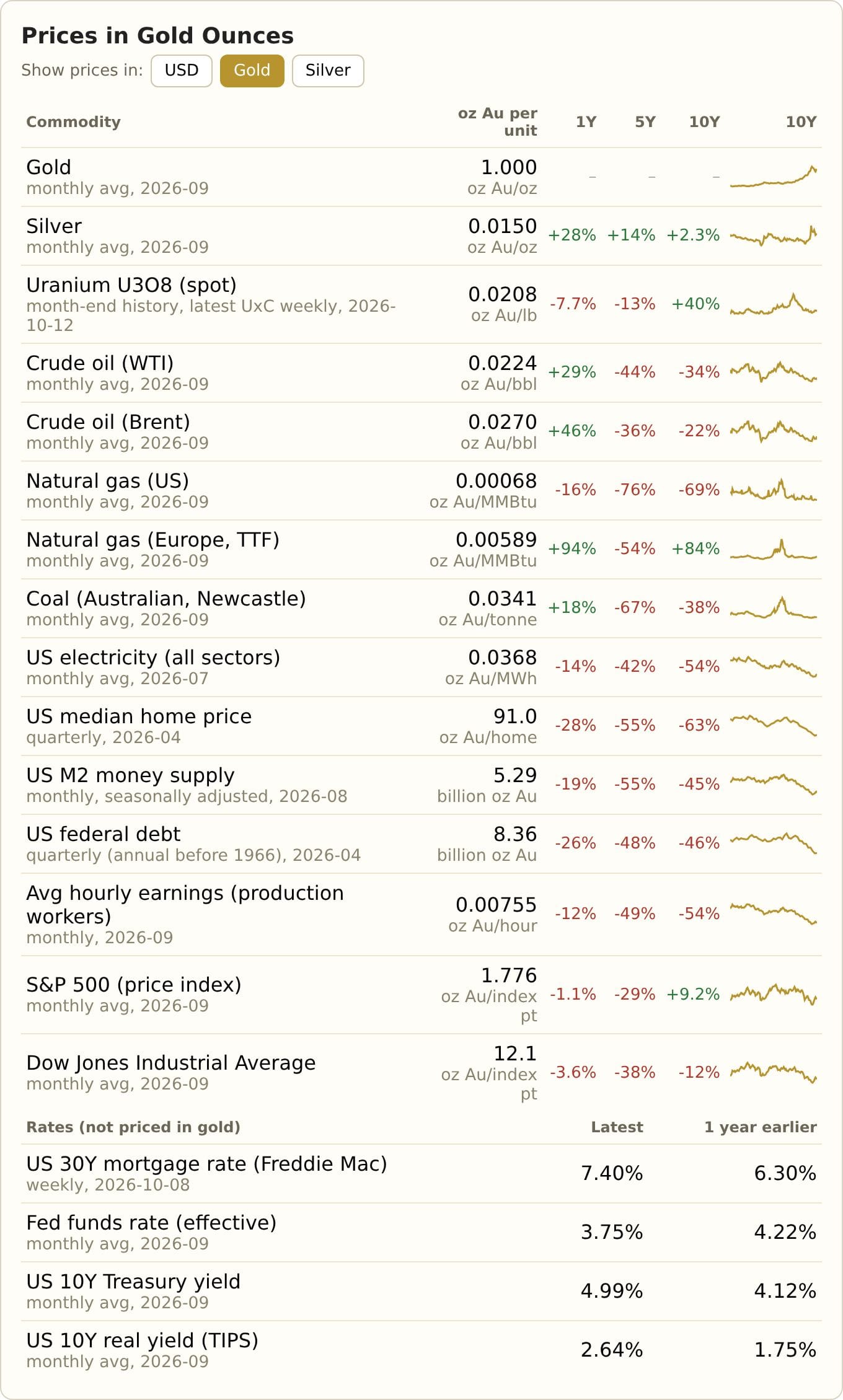
I've updated the website with a pricing model that shows a shortlist of the most important prices, priced in gold. The data is updated monthly intentionally as this model is intended to reduce noise. This is the data I've used to make my investment decisions, made available to everyone. It is now more accessible than a 100 page chart book or long list of prices. I'm quite excited that I was able to put this together, when I've been waiting 15y for someone else to recognize this problem and dish up a solution.
What this accomplishes is that it reduces the volume of prices, charts, and sources investors need to consume. It is a major noise reducer that allows investors to stick to the bigger picture. Each price included in the model pulls from a different location and is now available in one spot on our Prices page.
Here are a few links that I found a particularly interesting this week:
- Health Truth AI - Mark Kaplan with the help of several doctors in metabolic health and evolutionary biology fields have created Neo, a metabolic health AI bot. Bring your health problems, and it provides the metabolic perspective that your doctors won't tell you.
- Hidden Value in South Korea - Dan Rasmussen is founder and fund manager at Verdad Capital. He wrote an excellent article on South Korea's similarities to Japan.
- Mark's Daily Apple - This used to be my favorite nutrition and fitness website. It was offline for a long time but apparently it is back!
- Energetic Forum Archives - More than 320,000 posts from the Energetic Forum and Energy Science Forum archives: the Bedini build logs, the Dollard threads, Tesla, free energy, the replications that worked and the ones that did not. They now sit in the same search as the transcripts of 422 videos.
If you already invest, use the Prices in Gold model as a check against your dollar-denominated assumptions that feel certain.
This week's quote: "Financial advice is a trailing indicator of what recently worked. It offers tremendous insights if you're smart enough to be born twenty years earlier." - Joseph Moore