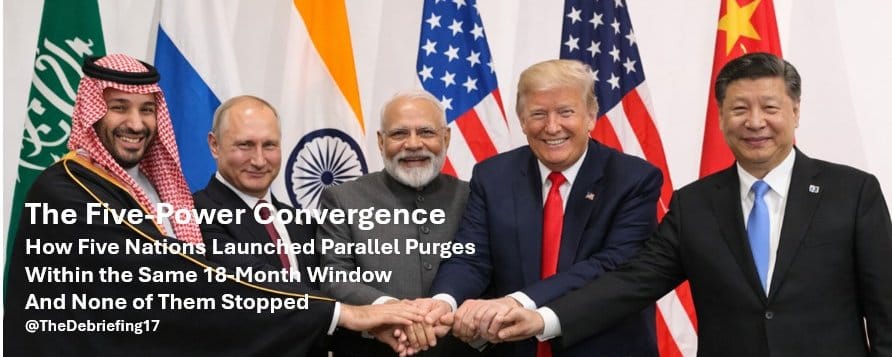
The Five-Power Convergence: How Five Nations Launched Parallel Purges

Both the mainstream news and narratives on social media generally ignore structural patterns. Our primary interest on this platform is digging deep, and identifying past and present structural processes that are moving us forward.
What follows is a shared post from X by @TheDebriefing17 @Homeranger17, highlighting patterns that have been shaping international geopolitics, and economics over the past 10 years.
Between November 2017 and March 2018, five of the world's most powerful nations launched anti-corruption purges, military restructurings, and financial enforcement campaigns that would fundamentally reshape the global order. None of them coordinated publicly. None of them announced a joint operation. And none of them have stopped.
The five nations: the United States, Russia, China, Saudi Arabia, and India.
Each pursued different targets through different methods. But the outputs are identical: the dismantling of entrenched elite power structures, the subordination of military leadership to executive authority, the seizure of unprecedented volumes of financial assets, and the construction of permanent enforcement architectures that survive leadership transitions.
This article documents 118 executive actions across these five countries from 2000 to February 2026. What follows is not a conspiracy theory. It is a chronological record of what happened, when it happened, and the pattern that emerges when you lay these events on a single timeline.
I. The Timeline Nobody Put Together
Most analysis of global enforcement treats each country as an isolated case study. Russia's oligarch purges are covered by Russia analysts. China's anti-corruption campaign is covered by China scholars. Saudi Arabia's Ritz-Carlton arrests were a Middle East story. India's demonetization was an economics story. America's crypto seizures were a law enforcement story.
Nobody put them on the same timeline. When you do, here is what you see:
2000: Russia activates. Putin inaugurates as president, summons 21 oligarchs to the Kremlin, and delivers the new rules: keep your wealth, stay out of politics. Within three years, the richest man in Russia is in prison, his oil company is nationalized, and two other oligarchs have fled the country. The template is set.
2001: The US builds the legal architecture. Post-9/11, Executive Order 13224 establishes the authority to freeze terrorist assets. The PATRIOT Act expands surveillance and financial monitoring. The machinery that will eventually seize $50 billion in cryptocurrency doesn't know it yet, but the legal foundation is being poured.
2012: China activates. Xi Jinping becomes General Secretary and launches the most extensive anti-corruption campaign in CCP history. 'Tigers and flies' no level immune. By 2025, over four million officials will be prosecuted. Both vice chairmen of the Central Military Commission are purged. The Eight-Point Regulation bans luxury for officials. This is not a policy adjustment. It is a restructuring of the Chinese state.
2014: India activates. Narendra Modi wins on an anti-corruption platform and launches a three-part sequence: the Black Money Act (2015) targeting offshore hidden wealth, the Benami Transactions Act (2016) targeting domestic shadow assets, and then the shock heard around the world demonetization.
November 8, 2016: India's demonetization. Modi withdraws 86% of all currency in circulation. $320 billion in banknotes rendered worthless overnight. Nothing like it had ever been attempted at this scale. The stated targets: black money, counterfeit currency, terror financing. The effect: a forced digitization of India's economy and a mass exposure of off-books wealth.
Four of five powers are now active. One remains.
II. The 18-Month Window
What happens between November 2017 and March 2018 is the most compressed period of simultaneous elite restructuring in modern history.
November 4, 2017 Saudi Arabia: The Night at the Ritz-Carlton. Crown Prince Mohammed bin Salman orders the detention of over 200 princes, ministers, and business leaders at Riyadh's Ritz-Carlton hotel. Among those detained: Prince Alwaleed bin Talal (major shareholder in Citigroup and Twitter), Prince Mutaib bin Abdullah (head of the Saudi National Guard), and dozens of the kingdom's most powerful economic figures. The government will recover over $106 billion. Reports of beatings and coercion emerge. The commander of the National Guard the only military force capable of mounting a rival challenge is neutralized. MBS consolidates control of all three branches of Saudi security forces in a single night.
December 20, 2017 United States: Executive Order 13818. President Trump signs what may be the most consequential executive order of the 21st century. EO 13818 the Global Magnitsky Sanctions declares a national emergency with respect to serious human rights abuse and corruption worldwide. It authorizes the Treasury Department, in consultation with State and the Attorney General, to freeze the assets of any foreign person involved in corruption, human rights abuse, or the transfer of proceeds of corruption. No prior notice required. No congressional approval needed per designation. And the cascade clause: anyone who materially assists a designated person can themselves be designated. One node unravels the network.The initial annex contains 13 names. By 2025, over 700 foreign persons have been designated. The order has been renewed every single year eight consecutive times, across three administrations, two parties. It has never been revoked. The annual reports to Congress include a classified annex.
February 2018 China: The National Supervision Commission. Xi Jinping establishes a new constitutional body that extends anti-corruption jurisdiction beyond CCP members to all state employees, SOE managers, and public institution administrators. The Supervision Law passes in March. The scope of who can be investigated expands massively.
March 2018 China: Term limits abolished. The National People's Congress amends the constitution to remove presidential term limits. Xi Jinping can now rule indefinitely. Combined with the anti-corruption campaign, the military purges, and the new supervisory apparatus, this represents total consolidation.Within this same window, Russia continues its military subordination under Putin (Serdyukov's 30% staff cuts institutionalized, military leadership entirely loyal). India's GST reform takes effect in July 2017, completing the financial transparency infrastructure begun with demonetization.
All five powers are now at maximum intensity. They activated independently, through different mechanisms, targeting different structures. But the convergence window is unmistakable: 18 months.
III. What They All Targeted
Despite operating in different political systems with different governance structures, all five powers targeted the same five categories:
1. Financial corruption and offshore wealth. The US built EO 13818 and the crypto enforcement pipeline ($50B+ in seizures). Russia forced de-offshorization. China prosecuted four million officials. Saudi Arabia recovered $106B at the Ritz-Carlton. India enacted the Black Money Act and demonetized.
2. Military independence. Russia purged independent-minded generals under Serdyukov and later arrested 12+ defense officials (2024). China removed both CMC vice chairmen and has now purged 8+ CMC members including Rocket Force commanders. Saudi Arabia neutralized the National Guard. India created the Chief of Defence Staff position and launched the Agnipath recruitment reform. The US restructured intelligence under the DNI.
3. Elite power centers and rival factions. Putin imprisoned Khodorkovsky and exiled Berezovsky and Gusinsky. Xi purged Zhou Yongkang, Bo Xilai, and Sun Zhengcai. MBS detained Prince Alwaleed and Prince Mutaib. Modi's enforcement agencies targeted opposition-linked financial networks. The US used EO 13818 designations to cascade through corruption networks globally.
4. Cryptocurrency and digital finance. The US seized 325,000+ BTC and established the Strategic Bitcoin Reserve. China banned Bitcoin mining (May 2021) and declared all crypto transactions illegal (September 2021). India proposed crypto taxation at 30% and pushed UPI as the digital alternative. Russia oscillated between crypto bans and digital ruble development.
5. Transnational crime networks. The US dismantled EncroChat (6,500 arrests), Sky ECC, and ANOM (800+ arrests). Cartel leaders were extradited across the Americas. The Hydra darknet market was seized with same-day OFAC sanctions. Chen Zhi's $15B pig butchering operation was taken down with 146 simultaneous OFAC designations.* * *
IV. The Parallel Military Purges
The military dimension is perhaps the most striking parallel, because it is the most dangerous category for any leader to touch. Purging your own military is a gamble that can end a regime. Yet all five did it.
Russia (2007–2025): Serdyukov's reform purged the officer corps. Shoigu was removed as Defense Minister in 2024 and replaced with an economist. Deputy Defense Minister Ivanov was sentenced to 13 years for $49M in embezzlement. Generals Bulgakov, Popov, Kuznetsov, and Shamarin were all arrested. After Prigozhin's mutiny and subsequent death, the remaining independent military leadership was eliminated.
China (2014–2025): Both CMC vice chairmen (Xu Caihou and Guo Boxiong) purged in 2014-2015. The PLA was restructured from 7 Military Regions into 5 Theater Commands. In 2023, the entire Rocket Force command was replaced. Defense Minister Li Shangfu removed. In 2025, CMC Vice Chairman He Weidong arrested and Admiral Miao Hua dismissed. Eight CMC members now purged under Xi the most extensive military house-cleaning since the 1960s.
Saudi Arabia (2017): The Ritz-Carlton purge neutralized Prince Mutaib bin Abdullah, commander of the Saudi Arabian National Guard the only military force outside MBS's direct control. With Mutaib detained, MBS consolidated command of the Army, National Guard, and intelligence services simultaneously.
India (2020–2022): The creation of the Chief of Defence Staff unified tri-service military command under a single advisor to the PM for the first time. The Agnipath scheme revolutionized recruitment. Combined with 'Make in India' defense manufacturing (30x increase in defense exports), this represents the most significant restructuring of Indian military governance since independence.
United States (2004–2025): Intelligence Reform Act (2004) restructured the IC under a DNI. Cyber Command stood up as a full unified command. The DOJ created dedicated cyber and crypto enforcement units. While not a 'purge' in the authoritarian sense, the institutional restructuring of the US security apparatus during this period was profound.
V. The Number That Matters
Here is the statistic that makes this pattern difficult to dismiss as coincidence:
All five powers activated within an 18-month window (November 2017 – March 2018). As of February 2026, none of the five have decelerated. No leadership change in any country interrupted the trajectory.
In Russia, the military purge is still producing arrests in 2025. In China, the anti-corruption campaign is in its 13th year and the number of officials prosecuted annually is increasing, not decreasing. In Saudi Arabia, Vision 2030 implementation continues with no reversal of the Ritz-Carlton consolidation. In India, the Agnipath scheme is operational and Modi secured a third term. In the United States, EO 13818 has been renewed by every administration since it was signed, the Strategic Bitcoin Reserve is operational, and crypto enforcement produced its largest seizure ever ($15B) in late 2025.
This is not a burst of activity that faded. It is a permanent restructuring that accelerated.
VI. Two Readings
Reading One: Convergent capacity. Five nations, each facing internal corruption and elite resistance to reform, independently arrived at similar solutions within a compressed time-frame. The tools were different but the institutional logic was the same: consolidate executive control, subordinate military leadership, seize financial assets, and build permanent enforcement architectures. The synchronization is emergent the product of shared global conditions (post-2008 financial crisis, rise of digital finance, encrypted communications enabling transnational crime) rather than coordination.
Reading Two: Something else. The 18-month convergence window, the identical target categories, the parallel military purges, the mutual non-interference (none of the five powers criticized each other's purges), and the fact that none decelerated despite leadership transitions in two of the five countries all of this is consistent with a shared understanding, if not active coordination, among the world's major powers that a global restructuring was necessary and would be mutually tolerated.
The data cannot tell you which reading is correct. What the data can tell you is that the pattern is real, the timing is compressed beyond what probability would suggest, and the trajectory is unchanged after eight years.
VII. What Comes Next
If the pattern holds and every testable prediction our framework has generated so far has been confirmed then we should expect:
EO 13818 to be renewed for a ninth consecutive year in December 2026. The classified annex to continue growing. New encrypted phone network compromises to produce fresh arrest waves. Additional military purges in Russia and China as wartime accountability pressures mount. The Strategic Bitcoin Reserve to grow through ongoing seizures. And the cooperation-pardon arc to extend to additional cooperators in traditional finance.
Every one of these is falsifiable. If the renewals stop, if the purges end, if the seizures slow the pattern breaks and the thesis weakens.
But after 118 executive actions across 25 years and 5 nations, with zero deceleration and zero interruption, the burden of proof has shifted.The question is no longer whether this is happening.The question is whether it was always the plan.