Currency Peg Fail

We're going to cover a lot of ground today. Hope you brought your reading boots.
In discussions about money, inflation, and banking there are handful of historical concepts that are very important to understand. Free Silver, Free Gold, and America's first currency fix under the 1792 Coinage Act are key to understanding monetary history and the current structural processes. In this author's view, the 15:1 gold:silver peg is the most important piece of American monetary history, and a case study in how not to run a monetary system. To explain why, we'll start with free gold and roll backwards through time.
"Gold is the money of kings, silver is the money of gentlemen, barter is the money of peasants, and debt is the money of slaves" - Norm Franz
Gold as a Free Floating Reserve Asset
Free Gold argues that gold should not be used as circulating money and should not be pegged to currency at a fixed price. Instead, both currency and gold should float freely. Currency handles daily exchange and credit expansion, while gold functions as a reserve asset and final settlement mechanism outside the credit system.
Under Free Gold thinking, gold’s role is price discovery, not payments. When confidence in currency weakens, gold rises in price, absorbing monetary stress without forcing a collapse of the currency itself. Importantly, Free Gold is a critique of gold standards and bimetallic pegs, not a call to “go back” to gold money. In practice, modern systems already resemble parts of this idea: gold is held by central banks, it is not redeemable by the public, and its price floats freely. What Free Gold does is articulate why pegging gold directly to currency has historically proven unstable.
The Impossible Trinity
Part of understanding Freegold, is understanding a concept called The Impossible Trinity, or the Monetary Trilemma. This is a foundational concept in economics that states a country cannot simultaneously have all three of the following:
- A fixed exchange rate
- Free movement of capital (money can move in and out freely)
- Independent monetary policy (control over interest rates and money supply)
A country can maintain any two, but the third must be sacrificed. Otherwise it is quite likely the country will default in some way.
With a fixed exchange rate and free capital movement, investors will arbitrage any interest-rate differences. That forces the central bank to match foreign monetary conditions. In practice, this is results in lost monetary independence. This is how classical gold-standard systems worked: domestic policy bowed to external flows.
To keep monetary independence and free capital movement, the exchange rate must float. When money flows in or out, the currency price adjusts instead of the interest rate. This is the modern system used by countries like the United States today.
To keep monetary independence and a fixed exchange rate, a country must control capital flows. That means restrictions on money entering or leaving the country. This approach has been used by countries prioritising domestic stability over financial openness.
Money of the People
Free Silver was not a technical monetary theory but a political movement that emerged in the 1870s. Its core demand was simple: the U.S. government should allow silver to be coined freely at a fixed ratio to gold, dramatically expanding the money supply. At the time, the United States was effectively operating on a gold-dominated system. Gold was scarce, credit was tight, and prices—especially agricultural prices—were depressed. Farmers and debtors felt trapped in a deflationary environment where debts became harder to repay over time.
Free Silver advocates understood that adding large amounts of silver money into circulation would raise prices, ease debt burdens, and rebalance power away from banks and creditors. Support came largely from farmers, populists, and western mining interests, while opposition came from financial centers and creditors who feared inflation and currency debasement. The movement peaked politically in the 1890s and ultimately failed, but it left a lasting imprint on American monetary debates by framing money not as neutral plumbing, but as a political tool with winners and losers.
The Coinage Act
When America passed the Coinage Act of 1792, it was not making an abstract philosophical statement about money. It was trying to survive. The country was newly independent, financially exhausted, and awash in foreign coins of varying weights and values. There were no deep financial markets, no national banking system, and little public trust in paper money after the collapse of Revolutionary War-era currencies.
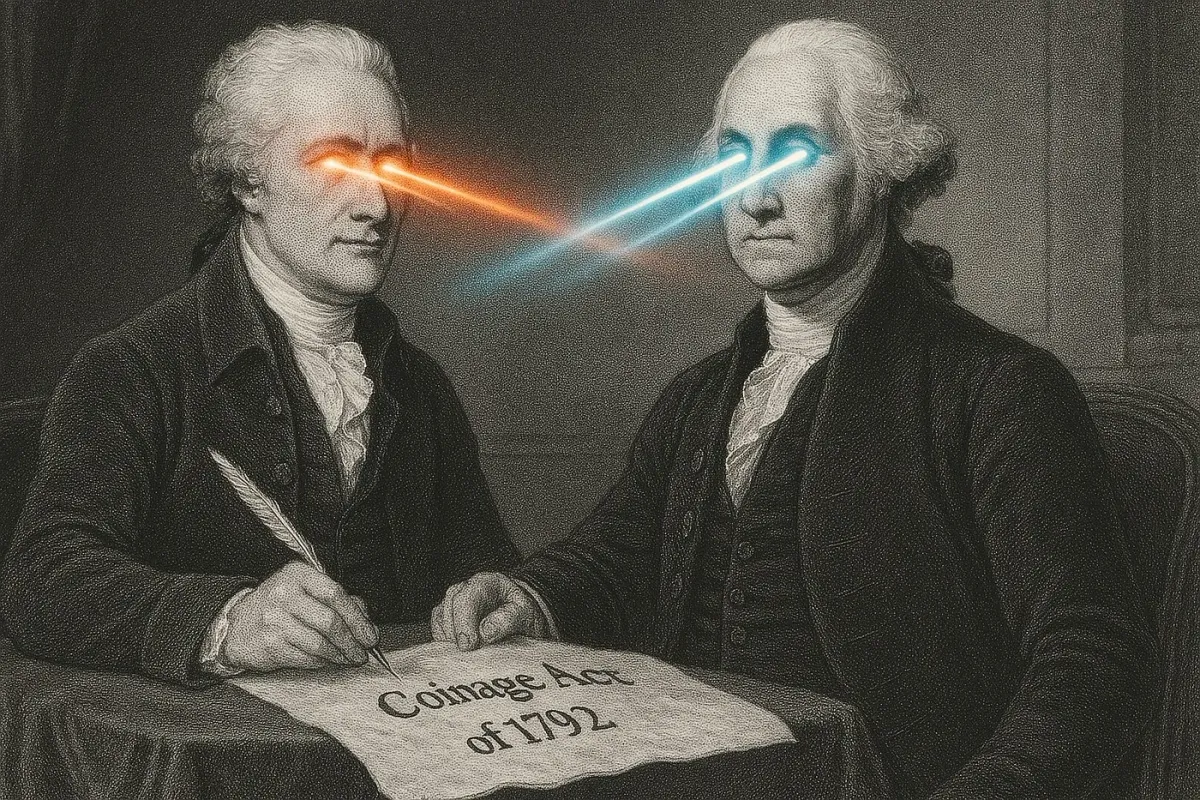
The architect of the system was Alexander Hamilton, the first Secretary of the Treasury. Hamilton proposed a bimetallic system in which both gold and silver would be legal money, fixed at a ratio of fifteen ounces of silver to one ounce of gold. This ratio roughly matched prevailing international market conditions and aligned with the Spanish silver dollar already familiar to American commerce. President George Washington backed the plan, Congress enacted it, and Thomas Jefferson, though skeptical, accepted it as a political compromise.
Hamilton’s background helps explain why he made these choices. Born in the Caribbean, orphaned young, and raised within the world of Atlantic trade, Hamilton learned finance not from theory but from ledgers, credit relationships, and shipping accounts. As a teenage clerk for wealthy merchants, he saw firsthand how commerce depended on trust, predictability, and enforceable obligations. Local patrons—merchants and a Presbyterian minister—recognized his talent, financed his education at Columbia University, and sent him to North America. He rose rapidly through Revolutionary War service as George Washington’s aide and emerged convinced that the survival of the republic depended on strong institutions and credible public credit.
Hamilton was not hostile to markets, but he was deeply wary of instability. To him, money was infrastructure. It had to work immediately, at scale, for ordinary people who transacted in coins, not abstractions.
Justification for the Currency Peg
The generally accepted view today is that allowing gold and silver to float freely sounds elegant in theory, and that in the 1790s it would have been unworkable. The United States lacked the institutional machinery needed to support floating prices. There were no liquid exchanges to discover daily metal ratios, no nationwide banking network to intermediate volatility, and no public familiarity with fluctuating units of account. Everyday commerce depended on physical coins, often counted by weight and trusted by custom rather than contract.
A floating gold–silver relationship supposedly would have meant constant repricing, confusion at the point of sale, and easy exploitation by arbitrageurs. For a fragile republic already struggling to establish legitimacy, that kind of chaos would have been fatal. The fixed peg simplified pricing, made coins interchangeable, and allowed the dollar to function as a stable unit of account.
Just as importantly, Hamilton’s true priority was not metal purity but public credit. Government bonds, taxation, and long-term finance all required predictable monetary foundations. Volatility in the money unit would have made U.S. debt unattractive and undermined confidence in the federal government. The peg was viewed as a stabilizer, not an ideological commitment.
Agrarian interests preferred silver; merchants preferred gold. A bimetallic system with a fixed ratio was the only arrangement capable of passing Congress. Floating metals would have looked like elite manipulation in a country still traumatized by paper money experiments and monetary disorder.
Hamilton understood the flaw in his own system. He acknowledged that fixed ratios would diverge from market ratios over time and that one metal would eventually disappear from circulation. He accepted this risk because a system that worked immediately was preferable to a theoretically perfect system that failed in practice.
Opposition to the Peg
No serious political faction in the early United States argued for freely floating gold and silver prices. The debate was not “fixed peg versus market float,” but rather how much federal control over money was acceptable and which metal should dominate. The resistance to Hamilton’s system came primarily from Jeffersonian Republicans, Anti-Federalists, and hard-money localists, and their objections were philosophical and political more than technical.
Thomas Jefferson was the most prominent skeptic inside the Washington administration. Jefferson distrusted fixed pegs because he believed they inevitably favored merchants, financiers, and international trade over farmers and local economies. He preferred silver as the primary money of account, seeing it as better suited to small transactions and less susceptible to elite manipulation. However, Jefferson did not advocate floating metal prices. He accepted the gold–silver peg as a temporary and politically necessary compromise, believing that silver would naturally dominate circulation and limit the practical influence of gold. His opposition was rooted in political economy, not monetary mechanics.
James Madison shared Jefferson’s unease but focused more directly on power. Madison worried that fixed ratios combined with federal assumption of debt would consolidate influence around the Treasury and permanently bind creditors to the national government. He understood that fixed pegs could distort markets over time, but like Jefferson, he did not propose a floating alternative. Madison’s resistance was aimed at the institutional architecture Hamilton was building, not at the idea of a fixed ratio itself.
Beyond the Cabinet, Anti-Federalists and hard-money localists opposed the peg as part of their broader resistance to centralized authority. Many rural Americans distrusted any national monetary standard after the collapse of Revolutionary War paper money. They preferred familiar silver coins, often foreign specie already in circulation, and feared that a national mint and Treasury-controlled ratios would allow elites to manipulate value at their expense. Their objections were emotionally powerful but politically diffuse. They lacked a unified monetary proposal, were divided between silver-only advocates and state-level control supporters, and had little institutional leverage by 1792.
What is crucial—and often not represented—is who did not exist in this debate. There was no meaningful constituency arguing that gold and silver prices should float freely according to market supply and demand. Such a system would have required deep capital markets, reliable price discovery mechanisms, widespread financial literacy, and institutional trust that simply did not exist in the early republic. Floating metals would have meant constant repricing, confusion in daily transactions, and easy exploitation by arbitrageurs—conditions that would have been disastrous for a fragile new nation.
Hamilton’s opponents ultimately lost not because they were ignorant, but because they offered warnings rather than workable infrastructure. Alexander Hamilton, backed by George Washington, presented a complete, executable system that solved immediate problems of trust, pricing, and public credit. His critics foresaw long-term distortions, and history proved them right, but in 1792 their alternatives could not function at scale.
The irony is that many of Hamilton’s critics were vindicated over time. Fixed ratios did distort incentives, one metal did disappear from circulation, and political conflict followed. But at the time, there was no unified support for a free-floating alternative.
Repeated Peg Failures
The gold–silver peg failed almost as soon as it was implemented. Global market ratios soon drifted closer to sixteen ounces of silver per ounce of gold, making gold undervalued in the United States at the official fifteen-to-one ratio. As a result, gold coins were exported or melted, while silver dominated domestic circulation. By the mid-1790s, the United States was bimetallic in law but effectively on a silver standard in practice. Jefferson was correct in thinking that silver would naturally dominate.
At the same time, Hamilton’s broader financial architecture took hold. The assumption of state debts, the creation of the Bank of the United States, and the expansion of federal credit markets tied the political elite, merchants, and creditors directly to the federal government. Money increasingly flowed through banks and paper credit, even though the public still thought in terms of coins. This dual system—metal for trust, paper for growth—worked tolerably well during periods of expansion but proved fragile under stress.
That stress arrived quickly. The Panic of 1796–1797, followed by the Panic of 1819, exposed how unstable credit-driven growth could be. Banks suspended specie payments, paper values collapsed, and ordinary Americans learned that the monetary system protected creditors far better than debtors. These crises did not produce immediate reform, but they seeded deep resentment toward financial institutions and centralized monetary authority.
By the 1820s, opposition to Hamilton’s system had hardened into a mass political force. This culminated in the rise of Andrew Jackson, who framed the existing monetary order as corrupt, elitist, and hostile to the common man. Jackson’s destruction of the Second Bank of the United States was not just a banking dispute—it was a referendum on Hamiltonian finance itself. Jacksonians viewed national banks, fixed monetary rules, and creditor dominance as tools of political control.
The political context mattered as much as the economics. The adjustment occurred during the presidency of Andrew Jackson, whose administration was openly hostile to centralized financial power, especially the Second Bank of the United States. Ironically, while Jackson opposed national banking, he favored hard money, and gold carried greater prestige as a “sound” monetary metal. Restoring gold coinage fit the political mood of asserting independence from banks while still supporting commerce.
Rather than openly admit that bimetallism could not be maintained at a fixed ratio, Congress chose a technical fix. The 1834 law effectively changed the ratio to about 16:1 by reducing the gold content of U.S. coins. This made gold overvalued domestically, pulling it back into circulation. The move worked—but only by flipping the distortion in the opposite direction. Silver now became undervalued and began to disappear instead.
Silver Boom
After the 1834 adjustment flipped the U.S. into a de facto gold standard, silver never truly recovered its monetary role. Silver coins circulated mainly in small denominations, while gold and paper credit dominated large transactions and international settlement. Bimetallism survived in statute more than in reality. The system worked only so long as silver remained relatively scarce and politically quiet.
That balance broke in the mid-19th century with massive new silver discoveries, especially in the American West. Strikes like the Comstock Lode in the 1850s and 1860s dramatically increased global silver supply. As silver became more abundant, its market value fell relative to gold. This made maintaining a fixed gold–silver relationship increasingly untenable. If silver remained freely coinable, it threatened to flood the monetary system, driving gold out entirely and destabilizing prices.
At the same time, the U.S. economy was industrializing rapidly. Railroads, factories, and national markets required large-scale finance, long-term bonds, and integration with European capital markets. Britain, the world’s financial center, was firmly on the gold standard. Gold was the metal of international settlement, credibility, and low borrowing costs. For financiers and policymakers, aligning with gold was less a philosophical choice than a practical one: gold lowered the cost of capital.
The Civil War accelerated these pressures. The U.S. suspended specie payments and issued greenback, proving that the economy could function without immediate metal backing. When policymakers later sought to restore credibility, they did not want to reintroduce a volatile bimetallic system just as global finance was converging on gold. Some would argue that Lincoln made an attempt to return to a silver coinage after the War.
In 1873, silver was formally demonetized, ending bimetallism altogether and igniting the political backlash that later became the Free Silver movement. From that came William Jennings Bryan and his famous free silver speech. And also Lyman Frank Baum's story, The Wizard of Oz.
There is a movie called the Secret of Oz which does a nice job of explaining the demonetisation of silver.
As silver prices fell further in the 1870s and deflation tightened its grip on farmers and debtors, it became clear what had happened. With silver no longer monetized, the money supply contracted relative to economic growth. Debts became harder to repay. Prices fell. What had seemed like administrative housekeeping was rebranded by critics as “the Crime of ’73.”
The Two Lessons
One lesson is very straightforward, fixed pegs between monetary assets always fail eventually. This comes down to the mechanics of The Triffin Dilemma. Some can be maintained longer, especially if backed by serious creditors. The American 1792 gold–silver peg failed within a few years. And it took nearly a century for the United States to fully abandon the illusion that it could be made to work.
The second lesson is the antithesis between the Founding Fathers in regards to the early monetary policies of the Republic. On one side the champions of the working class, and on the other the champions of finance. Free Silver demanded flexibility to relieve debt and deflation. Free Gold argues that stability and flexibility must be separated, currency for transactions, gold for settlement, so that neither destroys the other.
The author's view on these two lessons is a bit more cynical, and inline with Jefferson. He was one of the few who truly understood the value of silver coinage in relation to freedom from British financial interests. The peg was the primary tool that allowed British financial interests to interfere in and profit from the American Republic. The peg weaponized Gresham's Law, "overvalued money drives undervalued money out of circulation". This is a well known monetary concept in England that had been observed by Sir Thomas Gresham 200 years before 1792.
Jefferson was correct that free silver would naturally assert itself. This is clearly why he was ok with the peg. However, first the peg caused gold to leave, once it flipped it caused silver to leave. Meaning this created division and antithesis between the working class debtors who preferred silver, and the upper class creditors who preferred gold. It was used to alternatively drive one, and then the other metal out of circulation. Out of circulation meaning that money went overseas where it had more purchasing power.
What makes this conclusion very clear is the silver mining boom. All of the new silver lowered the silver price well below the 16:1 peg set in 1834, and drove gold out of circulation again. The Civil War and the greenback suspended silver coinage. The silver boom was still strong after the War. There was no reason to demonetise silver at that time except to protect gold and finance interests. With a strong silver mining sector, dependence on foreign creditors would be reduced. Ultimately it is the peg that caused the failure of the bimetallic standard. How much of this was due to monetary naivete? How much of this was an intended outcome? Leave a comment.